
Is The Feldenkrais Method Practical?
“I like the ideas, but does it actually help me move better in everyday life?”
It’s a fair question because Feldenkrais doesn’t look like your typical exercise class.
The movements are small.
There’s no sweating, no reps, no rules.
Sometimes, it even feels like nothing is happening.
So how does this seemingly subtle method translate to real-life change?
From the Floor to Your Life
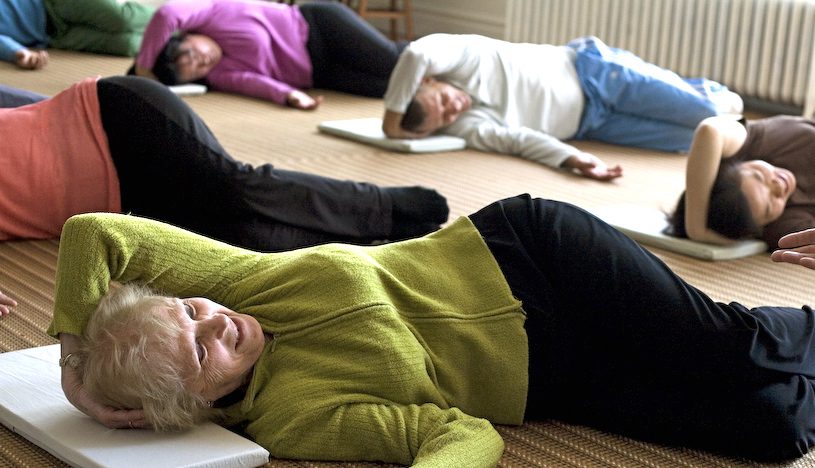
Many Feldenkrais lessons are done lying down, with curious instructions like:
- “Roll your pelvis.”
- “Sense your breathing.”
- “Soften your jaw.”
You might wonder:
“How is this going to help me carry groceries, climb stairs, or bend to tie my shoes?”
Here’s how:
The lesson is a training ground for awareness and a lab for trying new choices, safely and gently.
Let’s say your lower back has been bothering you. You join my “Getting to Know Your Hip Joints” series.
Over a few lessons, you begin to notice:
- You habitually stand with your knees locked, adding tension.
- You round your back to bend, instead of hinging at your hips.
- These habits may be why your back hurts.
Now you’ve got awareness and that’s powerful. But here’s where it becomes practical.
Choice In Motion
As you sense your patterns, you begin to experiment with alternatives.
What happens if you soften your knees?
You might find your pelvis can tilt more freely, allowing your spine to stay neutral and the strain in your back eases.
One small change—done differently a few dozen times a day—adds up fast.
After attending my shoulder series, a student told me,
“I didn’t realize how restricted I was when we started. The lessons were subtle but powerful…”
That’s the quiet power of Feldenkrais.
The moment something becomes optional, the old pattern often fades.
Not because you forced it, but because a better option made it irrelevant.
Real-Life Results You Can Feel
Change doesn’t always look dramatic from the outside.
But on the inside?
You might suddenly:
- Get up from the floor with less effort.
- Stop gripping the steering wheel so hard while driving.
- Notice you’re not bracing your shoulders every time you climb stairs.
And the best part?
You don’t have to memorize these shifts. Once you feel a better way, and practice it a few times, your nervous system remembers it.
More Than Just “Philosophy”
Sometimes people think:
“If it doesn’t make me sweat, how can it be effective?”
Here’s the truth: Feldenkrais isn’t about pushing harder. It’s about moving smarter.
It doesn’t hand you rules to follow. It gives you agency.
That means you don’t need someone else telling you what to correct.
You begin to feel what works, and act on it. The change becomes yours.
That’s why it’s practical: you gain the tools to keep learning and adapting— not just in class, but in real life.
One student put it beautifully after a series of lessons:
“I’m developing a new relationship with my body, allowing it to naturally support itself.
Whether I’m at the gym, sitting, or standing in line—I’m more aware of my alignment and how to adjust my posture to achieve greater balance and harmony.”
It’s experiences like this that remind me how powerful this work can be.
You May Also Like...
Is Awareness Enough For Change?
After my last email, “What is the Feldenkrais Method, Anyway?”, I received a thoughtful reply from a reader who had taken my recent series on...
What is the Feldenkrais Method Anyway?
I get asked this a lot and to be honest, it’s hard to put into words. The Feldenkrais Method® is something you really have to experience to...
No Results Found
The page you requested could not be found. Try refining your search, or use the navigation above to locate the post.