
How To Sit Without Strain
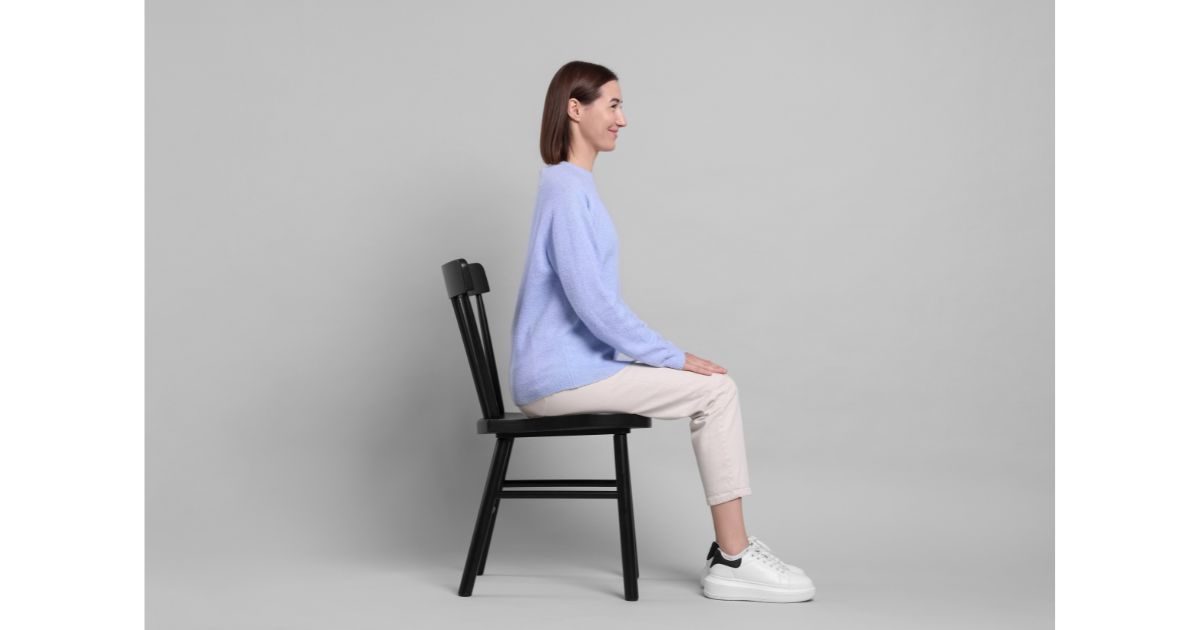
I suggested one simple change: every now and then, move toward the front of your chair instead of leaning back, similar to what you see in the photo above.
Most of us would consider this ‘good posture.’
But in trying to ‘sit up straight‘ you might throw out your chest, pin back your shoulders and even over-arch your lower back.
And very soon you find that you cannot maintain this position.
Because holding yourself up with muscular effort is tiring. Eventually, the muscles give up, and you slide into a slump.
So, what’s the alternative?
Sitting as “Standing” on Your Sit Bones
What are the sit-bones?
They are the rounded bony structures that form the bottom of your pelvis.
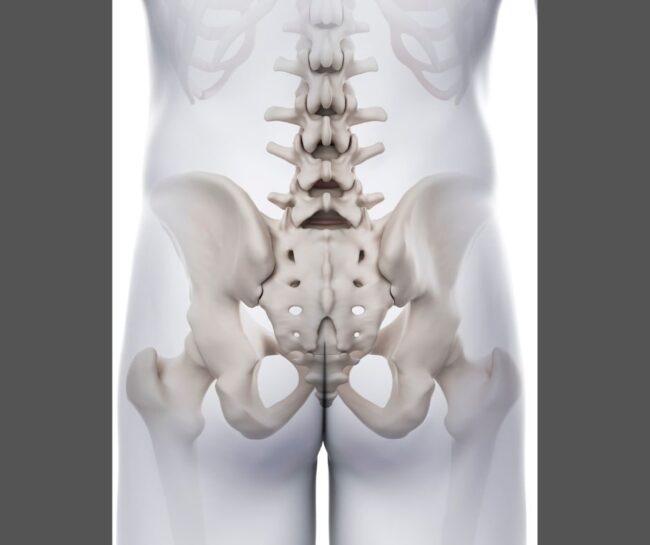
Here’s a simple way to feel them:
Sit toward the front of a firm chair. Let your knees be about hip width apart.
Make sure your feet are flat on the floor and your ankles are under your knees.
Now slide one hand under each buttock, fingers pointing upward.
Gently rock your pelvis forward and back. Do it slowly.
Feel the rounded bony shapes moving over your fingertips.
Those are your sit-bones.
Remove your hands and rock again. Then allow the weight of your torso to settle over those bones.
Do you feel the difference?
When your weight drops into your skeleton, your muscles don’t have to do extra work to keep you upright.
You’re not holding yourself up — you’re being supported.
Let’s Perch!
Most chairs put our hips at a 90° angle — and that angle isn’t particularly friendly to the hip joints.
A better option is what Galen Cranz calls perching.
In perching, the angle at your hips is greater than 90°.
Your thighs slope downward, and your knees are lower than your hips. In this position your sit-bones can support you better and your spine can retain its natural curves.
And you don’t have to buy fancy ergonomic chairs to do this. All you need is a stool that’s the right height.
As Galen explains in her Instagram Post:
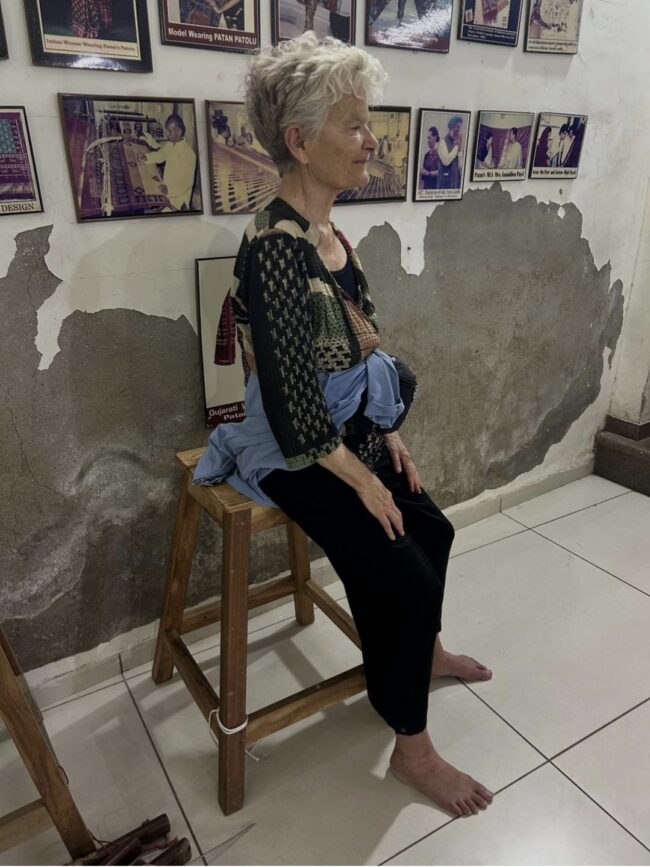
On a Moving Boundaries India field trip to the Patola Weavers’ workshop in Patan, where textiles are made by hand, I found this perfect perching height stool. It is extremely stable due to its slightly flared legs.
The knees are lower than the hips and sit bones, which means the sit bones can flare down and back and the spine can more easily find its natural upward S-shaped alignment. Right-angle sitting pulls the sit bones forward and under our bodies, causing the spine to crunch down into a C-shape, which cannot effectively bear the load of our heads.
If you don’t have a stool that’s the right height, you can place a folded blanket or two to raise the seat of a dining chair.
You’re aiming for a height that lets your thighs slope down rather than stay parallel to the floor.
Take a moment and look around your space.
Where do you spend most of your sitting hours? A soft couch? A desk chair?
Could you experiment with a stool? Could you adjust your seat height with blankets or towels?
And remember, no sitting position is meant to be held for hours.
So, every 30 min get up and walk a few steps.
There are other ways to support your spine, more about that later!
You May Also Like...

Hidden by Habit
Years ago, when I started paying attention to how I carry myself , I was surprised to discover how tense my left hand was—all the time. But that...
Strengthen Your Arches
When we think about what sets humans apart from other animals, the hand often comes to mind. Its versatility is incredible — from gripping heavy...

Go Barefoot
One thing that always catches my attention when I travel to India is the number of times I take off my shoes in a day — when you enter someone’s...