
The Ultimate Chair?
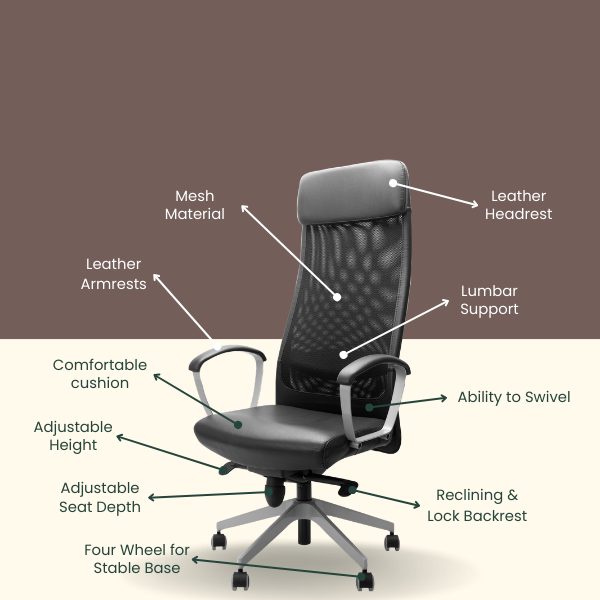
Which is the best chair?
I’m often asked which chair I recommend for sitting, which one is best for maintaining good posture. The honest answer is that no chair is designed to truly support the human body.
As Galen Cranz said during a presentation on human-centered design :
“Perhaps it’s not a chair design problem, rather a chair problem.”
In her work, Cranz talks about the central problem with chairs — their design imposes stillness. Straight-backed chairs, workstations, fixed seating impose rigidity on the human body even though it is designed for fluid motion. This mismatch between our biological needs and our furniture has negative effects on our comfort, attention, and long-term health.
The Hidden Problem with Chairs
A common issue with most chairs, no matter how ergonomic, is the seat tilt. Most chairs have a slight backward tilt, lowering your hips below your knees. Even a few degrees of tilt affects posture and breathing. When your knees are higher than your hips:
- Your spine rounds into a C-shape, straining your vertebrae
- Your chest collapses, restricting your breath
Maintaining a Neutral Spine
There are ways to sit that maintain a neutral spine, where the in-curves of the lower back and neck create an ‘S’ shape in the spine.
Sitting on a stool which allows the hips to be more open than 90°, floor sitting with support under the pelvis, these are ways in which you can support your spine to maintain its natural shape.
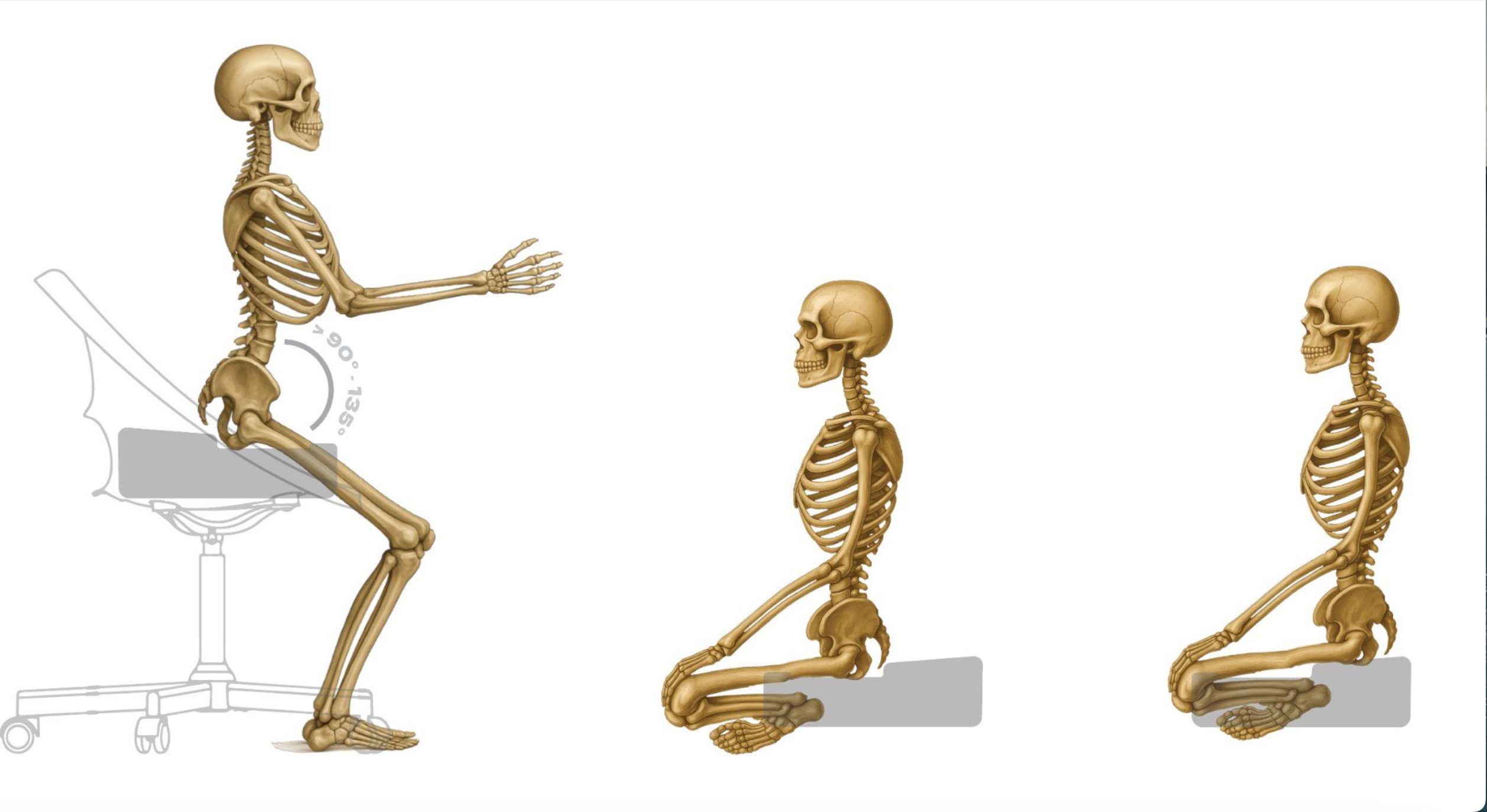
© Jay Jagad (https://www.karyashalla.com/)
And you don’t need any fancy chairs to do this. A stool of the right height is more than enough to bring your pelvis higher than your knees, in a position Galen calls perching.
As Galen explains in her Instagram Post:
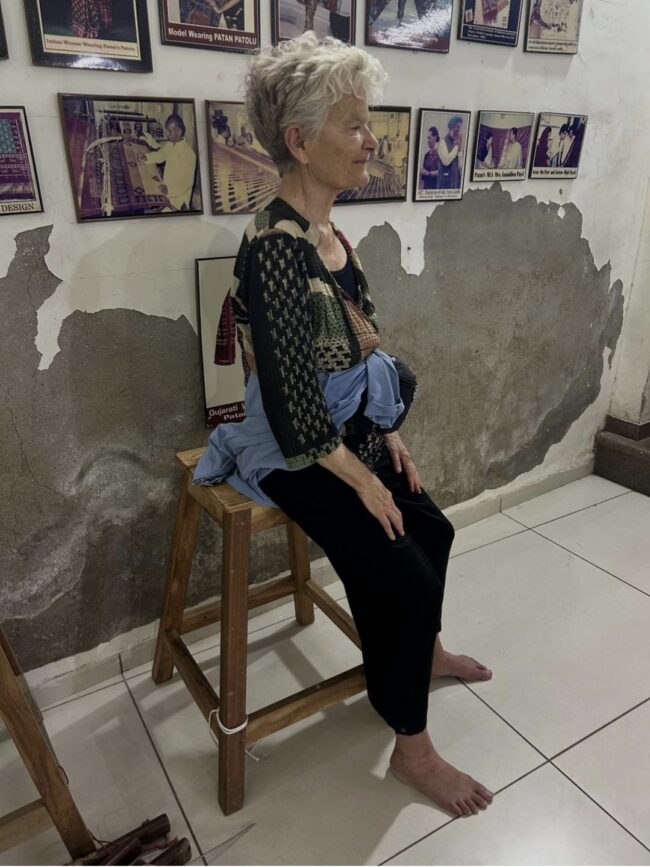
On a Moving Boundaries India field trip to the Patola Weavers’ workshop in Patan, where textiles are made by hand, I found this perfect perching height stool.
It is extremely stable due to its slightly flared legs. The knees are lower than the hips and sit bones, which means the sit bones can flare down and back and the spine can more easily find its natural upward S-shaped alignment. Right-angle sitting pulls the sit bones forward and under our bodies, causing the spine to crunch down into a C-shape, which cannot effectively bear the load of our heads.
Kneeling, squatting, sitting cross-legged...
The floor supports a variety of positions that chairs and desks don’t but we have many unconscious cultural assumptions about certain sitting positions. As Galen Cranz explains:
“Squatting, for example, we think of as very primitive. But children squat very well, and in cultures where people still squat, women don’t have problems in labor. So squatting is really healthy. People around the world eat, work, and wait squatting, but the West views that as a sign of poverty and being “less developed.” An anthropologist named Gordon Hughes studied postures around the world, and he argued that the West really needed to look at the work postures of other cultures and integrate them into our life. Kneeling, squatting, sitting cross-legged, lounging— these are all perfectly useful positions.
It’s not that it’s bad to sit; it’s just that it’s bad to sit for very long. There is no perfect single position. As a species we’re designed for movement and change.”
Galen Cranz, Interview with Portland Spaces
You May Also Like...

Hidden by Habit
Years ago, when I started paying attention to how I carry myself , I was surprised to discover how tense my left hand was—all the time. But that...
Strengthen Your Arches
When we think about what sets humans apart from other animals, the hand often comes to mind. Its versatility is incredible — from gripping heavy...

Go Barefoot
One thing that always catches my attention when I travel to India is the number of times I take off my shoes in a day — when you enter someone’s...