
Close Your Eyes & Point to Your Elbow
Brainscapes, by Rebecca Schwarzlose
The Body Knew First — Part 3 of 4
(Four short reads on the neuroscience of movement, and what it means for how you live in your body).
Here are the first 2 parts in case you missed them:
Why Do We Have Brains?
A Brief History of Intelligence by Max Bennett
The Fastest Way To Understand Anything
A Thousand Brains by Jeff Hawkins
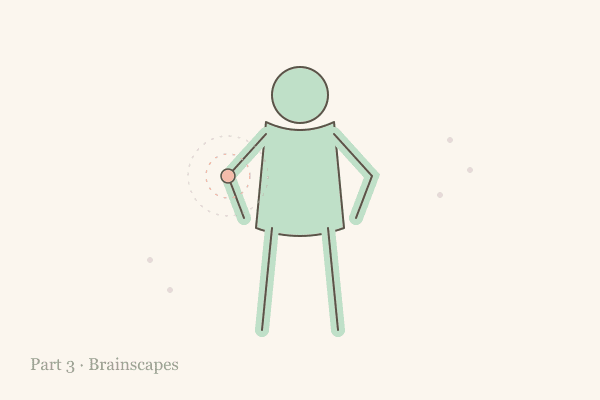
Close your eyes right now and point to your left elbow.
You didn’t need to look.
You probably didn’t even need to think about it.
How does your brain know exactly where that is, at every moment, without checking?
That small, ordinary trick is the doorway into Rebecca Schwarzlose’s Brainscapes.
Schwarzlose, a neuroscientist, spends the book unpacking a strange and slightly destabilizing idea: your experience of the world isn’t simply handed to you as it “really” is.
Your brain is actively building it, moment to moment and one of the main things it’s building is a set of internal maps.
Maps of your body. Maps of the space around you. Maps of other people.
Even a map of your own sense of self.
These aren’t maps in a loose, poetic sense. They’re real, physical patterns of organization in your nervous system, doing constant, quiet work you never notice.
They’re the reason you can sense your elbow without looking, feel your foot land before you consciously register it, pick a familiar face out of a crowded room, or know which way is “forward” in an unfamiliar space.
None of that is passive perception. It’s active, ongoing map-making.
Here’s the part that should sound familiar if you’ve ever spent time in a Feldenkrais lesson, even without knowing the term for it: Moshe Feldenkrais called this same thing your “self-image” — decades before anyone could observe it with a brain scanner.
His insight was that this internal map isn’t a fixed, factual blueprint of who you are. It’s more like a working draft, built out of movement and experience, and — critically — a draft that can be redrawn.
That’s not just theory.
One of the more striking, almost startling things about a well-taught Awareness Through Movement lesson is how quickly this can happen.
People often notice a shoulder, a hip, or a leg feeling distinctly different — lighter, more available, easier to locate — by the end of a single class, without having done anything that looks like stretching or strengthening. What’s actually shifted is the map, not the tissue.
If you’d like to feel your own map update in real time rather than just take that on faith, that’s exactly what an Awareness Through Movement class is built to let you notice.
No experience needed — just a willingness to pay attention to what changes.
Next: if these internal maps really can change this easily, the obvious question is how. That’s exactly where the last book in this series picks up.
Stay tuned.
Ravi
PS: If the idea that your internal map can be redrawn has you wondering whether just noticing something is enough to actually change it, I tackled that question head-on here:
Is Awareness Enough For Change? (Short answer: awareness is the foundation — but there’s a layer past that too).
One more thing: this September, I’m running an 8-week series built entirely around this idea — applied to one of the most map-confused, tension-holding parts of the body. You can find the details here
You May Also Like...
No Results Found
The page you requested could not be found. Try refining your search, or use the navigation above to locate the post.

Shoulders & Shoulda’s
Shoulders, Stress, and Stiffness: The Ripple Effect In my last email, I shared how the shoulders are intimately connected to the chest and spine....
No Results Found
The page you requested could not be found. Try refining your search, or use the navigation above to locate the post.