
Why Do We Have Brains?
Why Do We Have Brains?
The Body Knew First — Part 1 of 4
(Four short reads on the neuroscience of movement, and what it means for how you live in your body).
Hi there, Ravi here
Next time you’re stuck on a hard problem, notice what you actually do.
Most people don’t sit and stare harder. They get up. They pace, or go for a walk, or start doing the dishes and somehow the answer arrives sideways, while their body is busy doing something else entirely.
Why does that work?
Max Bennett’s A Brief History of Intelligence goes back roughly 600 million years to answer a version of that question, and the answer reframes almost everything else you think you know about your own mind.
Bennett, an AI entrepreneur turned neuroscience researcher, traces human intelligence through five evolutionary breakthroughs, each one still fully present in your brain today:
-
Steering, in the earliest bilateral animals;
-
Reinforcement learning, in early vertebrates;
-
Simulation, in mammals;
-
Mentalizing, in primates; and
-
Speaking, in humans.
Each one got built on top of the last, the way a new floor gets added to a building without demolishing what’s underneath.
The first one is the one worth sitting with.
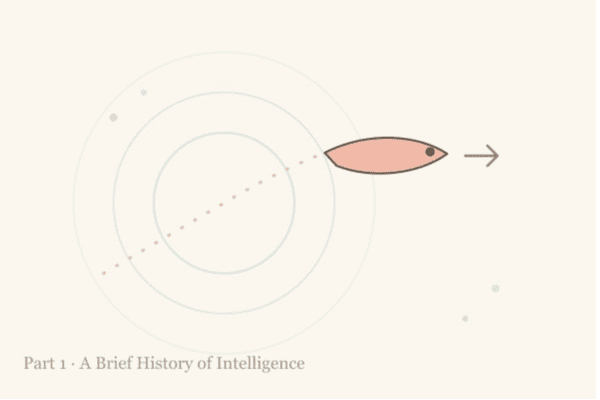
The very earliest nervous systems on Earth didn’t evolve to think, remember, or feel anything.
They evolved to solve exactly one problem: which way to move. A simple worm-like creature needed some way to turn toward food and away from danger — nothing more sophisticated than that.
That narrow job, steering, is the entire reason a nervous system exists in the first place.
There’s a strange, vivid illustration of what happens when that job disappears. The sea squirt swims freely as a larva, guided by a simple cluster of neurons doing exactly one thing: helping it navigate.
Once it finds a rock, attaches itself permanently, and never needs to move again, it digests its own brain. No more steering to do, no more need for the equipment steering required.
Here’s the part that lands differently once you know that: your brain, right now, is a direct descendant of that original steering system.
Learning, imagining, understanding other people, language — all of it got layered on top, later, but none of it replaced the foundation.
Movement isn’t one ingredient in your intelligence, mixed in alongside thinking and feeling. It’s the ground everything else was built on.
This happens to be the working assumption behind the Feldenkrais Method, developed decades before anyone could trace intelligence back through the fossil record this way.
The premise is that movement isn’t just exercise for the body — it’s the oldest, most basic operation your nervous system has, which also makes it one of the most direct ways to reach it, reorganize it, and change how it works.
The easiest way to feel that for yourself, rather than just read about it, is to try a single Awareness Through Movement class.
There’s nothing to get right and no experience required — just about twenty minutes of noticing what happens when you let your oldest, most fundamental system do the one thing it was originally built to do.
Next: once you know movement is the foundation, the obvious question is what your brain actually does with it — how it turns motion into a model of the world. That’s where the next book in this series picks up.
Stay tuned.
Ravi
PS: If you enjoy reading interesting books on neuroscience like I do, check out these other reviews on my blog:
-
The Body Has A Mind of Its Own by Sandra and Matthew Blakeslee
-
7½ Lessons About the Brain by Lisa Feldman Barrett
You May Also Like...
No Results Found
The page you requested could not be found. Try refining your search, or use the navigation above to locate the post.

Shoulders & Shoulda’s
Shoulders, Stress, and Stiffness: The Ripple Effect In my last email, I shared how the shoulders are intimately connected to the chest and spine....
No Results Found
The page you requested could not be found. Try refining your search, or use the navigation above to locate the post.